


 Australia
 Ghana
Ghana Kenya
Kenya Morocco
 Nigeria
 Romanian
 Rwanda
 Tanzania
 Uganda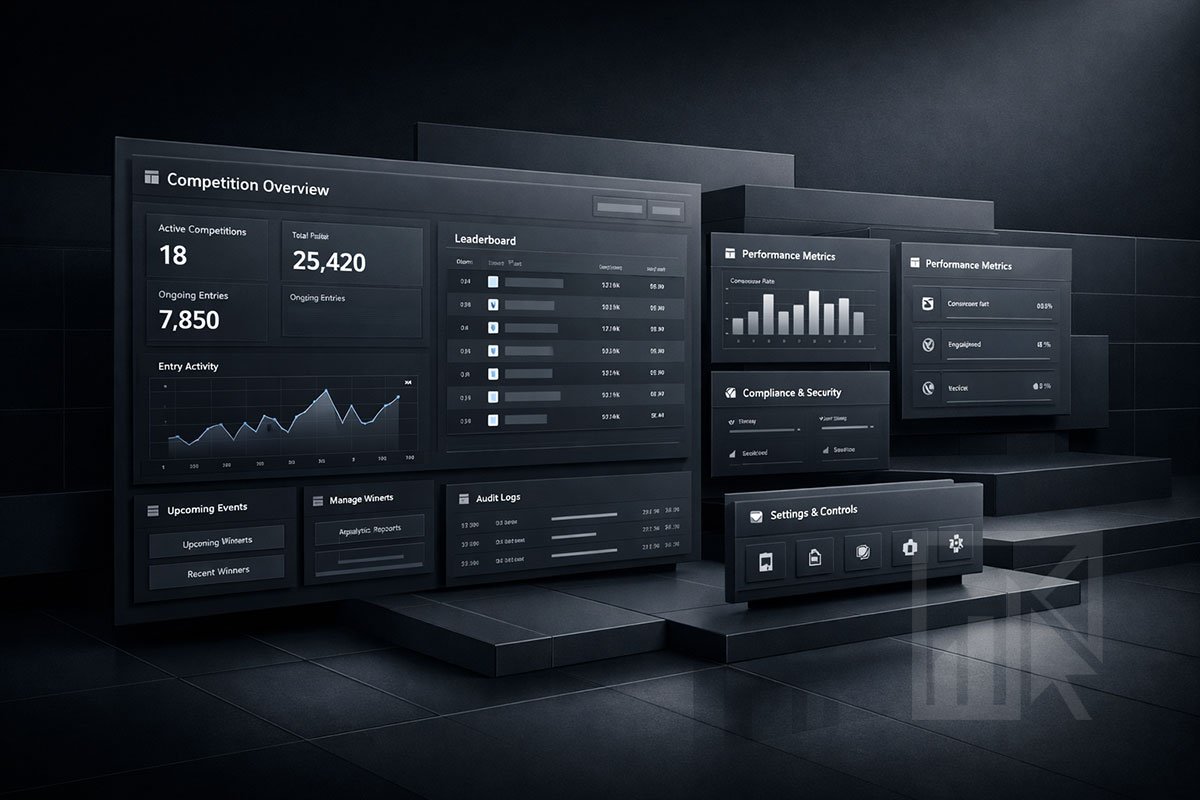
The Building Blocks of a Scalable, Legal, Business-Ready Competition Website
Most founders think an online competition platform is a “website with competitions.”
In reality, it’s a system of rules, data, and workflows that must remain reliable under growth, payments, and scrutiny.
This article breaks down the core architecture of an online competition platform—what it’s made of, how components interact, and what must be designed correctly from day one.
This article is part of
Online Competition Platforms: The Complete Guide
The Platform Mindset: Systems First, Pages Second
A competition platform is built around:
State (what’s true right now: entries, user status, competition phase)
Rules (what is allowed, when, and under what conditions)
Auditability (the ability to prove what happened)
A “website mindset” focuses on pages.
A “platform mindset” focuses on logic and integrity.
The Core Components (Platform Blueprint)
A business-ready online competition platform typically includes these modules:
- Identity & Accounts
- Competition Engine
- Entry & Ticket Logic
- Payments & Financial Controls
- Draw / Scoring / Outcome System
- Admin & Operations Dashboard
- Transparency, Terms & Compliance Layer
- Automation & Notifications
- Reporting, Logging & Audit Trails
- Security, Fraud Controls & Data Protection
- Scalability & Infrastructure
Let’s break them down.
1) Identity & Accounts (Users Are the Root of Everything)
The identity layer handles:
- Registration and login
- Account verification (if required)
- User profiles and participation history
- Access rules (eligibility, geography, age, bans)
Why it matters
Competition platforms are repeat-use businesses.
You must track who did what, when, and under which conditions.
If identity is weak, the platform becomes unmanageable.
2) The Competition Engine (The “State Machine”)
The competition engine defines:
- Competition creation and configuration
- Lifecycle stages (draft → live → closed → processing → completed)
- Entry windows, limits, and conditions
- Prize details and fulfilment status
Think of it like this
A competition is not a web page.
It is a living object with states and rules.
Platforms fail when this logic is scattered across plugins and manual steps.
3) Entry & Ticket Logic (The Rules of Participation)
This module handles:
- How entries are generated
- Ticket numbering and uniqueness
- Limits per user
- Limits per competition
- Free entry routes (if applicable)
- Anti-duplicate protections
Why it matters
This is where most disputes, errors, and payment issues originate.
A strong entry system ensures:
- fairness
- consistency
- repeatability
- transparency
4) Payments & Financial Controls (Money Is Not a Button)
Payments are a system, not a checkout.
This module must handle:
- Payment processing
- Webhooks and payment confirmation
- Refund logic and chargeback handling
- Failed payments
- Fraud checks
- Ledger or transaction logging
Critical rule
Entries should only be confirmed when payment is confirmed (or when a valid free route is confirmed).
Separating entries from payment confirmation creates chaos.
5) Outcome System (Draws, Scoring, or Instant Wins)
This module depends on competition type:
Chance-based
- Random draw logic
- Secure randomness (and proof of fairness)
- Tie-handling and edge cases
Skill-based
- Scoring rules
- Validation and anti-cheat
- Clear winner calculation
Instant-win
- Probability logic
- Inventory of prizes
- Audit trails for win allocation
Why it matters
Outcome logic is where credibility is won or lost.
If users don’t trust results, they don’t return.
6) Admin & Operations Dashboard (Control Without Chaos)
The admin panel must allow:
- Creating, editing, and scheduling competitions
- Monitoring live status
- Viewing entries and users
- Handling disputes and refunds
- Pausing competitions if needed
- Exporting logs and reports
If you can’t confidently answer:
“What is happening in the system right now?”
You don’t have a platform—you have a risk.
7) Transparency, Terms & Compliance Layer (Embedded, Not Added)
This includes:
- Clear rules per competition
- Eligibility and restrictions
- Draw timing and method explanation
- Public results announcements
- Terms and policies that reflect real platform logic
Important: Compliance is not a page you add at the end.
It is a logic layer that must match how the platform behaves.
8) Automation & Notifications (Scale Without Manual Work)
Automations include:
- Confirmation emails and receipts
- Draw reminders and closing notifications
- Winner notifications
- Fraud alerts
- Admin alerts for anomalies
Automation reduces:
- support load
- human error
- operational delays
Manual operations kill platforms at scale.
9) Reporting, Logging & Audit Trails (Proof and Protection)
A serious platform keeps:
- Entry logs
- Payment logs
- State-change logs (what changed, when, by whom)
- Draw result logs
- Admin activity logs
This is not “extra.”
It is what protects the platform when issues arise.
10) Security, Fraud Controls & Data Protection
Key elements include:
- Rate limiting and bot protection
- Duplicate account controls
- Payment fraud checks
- Secure storage of sensitive data
- Access control and admin permissions
- Backups and recovery plans
- Data protection practices (UK/EU users: privacy compliance matters)
Even small platforms are targets.
Security must be designed early.
11) Scalability & Infrastructure (Surviving Success)
Scalability includes:
- Performance under spikes
- Caching strategy
- Database integrity under load
- Queue systems for jobs (emails, draws, reporting)
- Monitoring and alerting
- Clean upgrade paths
Platforms that scale well don’t “work harder”—they run smarter.
The Minimum Viable Platform (MVP) That Still Works
If you want a lean build, the MVP should still include:
- Accounts & identity
- Competition engine with clear states
- Entry logic with limits
- Payment confirmation logic
- Outcome system (draw or scoring)
- Admin dashboard
- Basic logging + transparency
Anything less may launch, but it won’t survive.
Final Thought
A competition platform is not built on pages.
It’s built on rules, state, logs, and control.
The founders who win are the ones who build:
- predictable systems
- repeatable operations
- transparent outcomes
- scalable architecture
Build once. Build like it must survive success.
Continue Reading
- Online Competition Platforms: The Complete Guide
- Competition Website vs Platform: What Founders Get Wrong
- Build vs Buy: Themes, Plugins, and Custom Platforms

Comments are closed.